
In the heart of Mississauga’s thriving manufacturing sector, the ability to adapt, repair, and innovate is the key to staying competitive. There is a common misconception that manufacturing always begins with a brand-new digital design. But what happens when a critical part fails on a legacy machine, and the original drawings are lost to time? What if a complex, organic shape needs to be replicated for a custom automotive or aerospace component? This is where the transformative power of reverse engineering comes into play.
For businesses accustomed to traditional manufacturing, the journey from a physical part to a finished product can seem mysterious. However, at Gegal Machine Tools, we bridge this gap every day. By integrating advanced 3D scanning with our expert CAD/CAM programming services, we turn physical objects into digital assets, ready for precision machining. This guide will walk you through that journey, explaining how a physical part becomes a digital model, and finally, a brand-new, precisely machined component.
Part 1: Demystifying Reverse Engineering
To understand the process, we must first shift our perspective on design. The conventional “forward” engineering process is linear: you have an idea, you create a design in Computer-Aided Design (CAD) software, and then you manufacture the part. Reverse engineering, as the name suggests, flips this script .
In manufacturing, reverse engineering is the process of deconstructing a physical object to understand its design and capture its exact geometry. The goal is to create a digital 3D model of an existing part when no such model exists . This is not about simple copying; it is about capturing data—the precise dimensions, curves, and features that define a component.
Think of it as digital archeology. Instead of digging for artifacts, we use advanced technology to extract the blueprint of a physical item. This blueprint then becomes the foundation for reproduction, redesign, or improvement. At Gegal Machine Tools, we use this process to solve real-world problems for manufacturers across Mississauga, from reviving obsolete machinery parts to creating production-ready files for complex prototypes .
Part 2: The First Step – Capturing the Physical World (The Scan)
The journey from a physical part to a digital file begins with data capture. Gone are the days of manual measurements with calipers for complex geometries. Today, we use sophisticated 3D scanning technology to create a digital “fingerprint” of the object .
How 3D Scanning Works
A 3D scanner, often a handheld device, projects light (usually laser or infrared) onto the surface of an object . As the device is passed over the part, it captures millions of data points, measuring the distance from the scanner to the surface with incredible accuracy. This process is similar to how sonar maps the ocean floor, but on a microscopic level and at rapid speed .
The result is a highly accurate digital representation of the part, composed of millions of individual points, known as a “point cloud.” This point cloud is the raw, unprocessed digital twin of your part . For a complex item like a custom automotive bracket or a worn-down impeller from industrial equipment, scanning captures every nuance that manual measuring would miss.
From Points to Polygons
Once the point cloud is captured, specialized software immediately begins its work. It connects the dots to form a polygonal mesh—a surface comprised of thousands of tiny triangles. This mesh is a visually accurate 3D representation of the part, often saved as an STL file . At this stage, you can see the part on a screen, rotate it, and inspect it from every angle.
However, while visually accurate, this mesh is not yet a true CAD model. As one industry expert notes, importing a triangulated surface directly into CAD software results in a “dead surface”—useful for reference but ineffective for engineering and manufacturing . This is where the true art of reverse engineering begins .
Part 3: The Digital Transformation – From Mesh to Machinable CAD
The transition from a polygonal mesh to a parametric CAD model is the most critical step in the process. It transforms a static visual copy into an intelligent, editable, and machinable digital file. This is the core of what we do at Gegal Machine Tools.
The Challenge of “Dumb” Data
Raw scan data, while beautiful, is “dumb.” It doesn’t understand that a cylindrical protrusion is a shaft, or that a hole has a specific diameter and tolerance. If you were to try and machine directly from the mesh, the CAM software would see a complex, uneven surface, making it nearly impossible to generate efficient and accurate toolpaths . Furthermore, you cannot easily change the diameter of a hole in a mesh file; you would have to re-scan the part.
Building the Smart Model
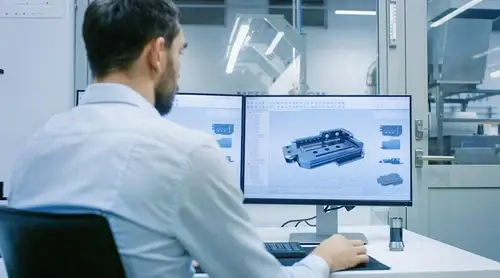
This is where our CAD expertise shines. Using industry-leading reverse engineering software—tools that are often tightly integrated with platforms like Mastercam and Solidworks—our programmers take the mesh and rebuild it as a parametric solid model .
This process, sometimes called “surface reconstruction,” involves identifying and recreating the part’s features . The software helps us extract geometric primitives—planes, cylinders, lofts, and curves—from the mesh data . We then use these features to construct a precise, watertight solid model.
The magic of this parametric model is its intelligence. It has a design history. It knows that a specific face is related to a sketch and a previous extrusion. This means the model is fully editable. If a client needs the wall thickness increased by 2mm or a bolt hole pattern changed, we can make that adjustment in minutes, not hours . The final product is a native CAD file (like a .STEP or .IGES) that is perfectly optimized for the next stage: programming the CNC machine .
Part 4: Bringing It to Life – CAM Programming and Machining
With a clean, intelligent CAD model in hand, the project moves into the CAM (Computer-Aided Manufacturing) phase. This is where we answer the question: “How will we actually make this part?”
Defining the Manufacturing Strategy
CAM programming is far more than just clicking “auto-generate.” It is a strategic process that requires deep knowledge of materials, tooling, and machine capabilities. At Gegal Machine Tools, our programmers begin by analyzing the new CAD model to determine the most efficient and accurate way to machine it.
They consider factors like:
- Material: Is it aluminum, steel, titanium, or plastic? This dictates cutting speeds, feed rates, and tool selection.
- Geometry: Are there deep pockets, tight internal corners, or complex 5-axis contours?
- Tolerance: How precise does the final part need to be?
Generating the Toolpath
Based on this strategy, the CAM software is used to generate the toolpath—the precise route the cutting tool will follow to remove material from a raw block. Modern CAM software is incredibly powerful. It can create dynamic toolpaths that optimize cutting angles to reduce stress on the tool and machine, and it can simulate the entire machining process in virtual space .
For a part that originated from a scan, this simulation is vital. We can run the program virtually, checking for collisions, verifying that the tool can reach all necessary areas, and ensuring the final part matches the scanned geometry perfectly. This saves immense time and money by preventing crashes and scrap material on the shop floor.
The Final Product
Once the program is verified and optimized, it is posted to the CNC machine. The machine reads this code and, with precision down to thousandths of an inch, cuts the final part. The result is a brand-new component that is either an exact replica of the original or an improved version of it, ready for service.
Part 5: Real-World Applications in Mississauga
The “Scan to Part” capability is not just a technological novelty; it is a practical solution to daily challenges faced by local industry. At Gegal Machine Tools, we have seen this process deliver results across multiple sectors.
1. Legacy Machine Repair
A manufacturer has a 30-year-old machine that is critical to their production line. A gear or housing breaks. The original manufacturer is out of business, and replacement parts are unobtainable. We can scan the broken piece (or its mating part), reverse engineer it into a CAD model, and program a new one. The machine is back online in days, not months, saving the business from costly downtime.
2. Automotive and Aerospace Innovation
In high-tech sectors, prototyping is key. An engineer has a hand-sculpted clay model or a modified physical prototype of an intake port or a bracket. They need to test it in a digital environment and then produce a metal version. We scan the physical prototype, create the CAD model, and generate the complex 5-axis toolpaths required to machine it from billet . This seamless workflow accelerates the R&D cycle dramatically.
3. Consumer and Industrial Goods
Consider a company that manufactures ergonomic tools or sporting goods. They might have a master pattern that is perfect for feel but needs to be digitized for mass production. Scanning captures the organic shape, and our CAD/CAM programming prepares it for mold-making or direct machining . This ensures that the mass-produced item retains the exact feel and function of the handmade original.
4. Part Improvement and Optimization
Sometimes, a physical part works well but could be better. Perhaps it is too heavy, or a specific feature is prone to failure. By creating a CAD model from the part, we gain the ability to analyze and improve it. We can add lightweighting structures (like honeycomb infill), strengthen weak points, or add new mounting features, all before machining the new-and-improved version .
Conclusion: Bridging the Physical and Digital Worlds
The journey from a physical part to a finished product is a perfect example of how modern technology solves old problems. It is a collaborative process that combines the precision of 3D scanning, the intelligence of CAD modeling, and the power of CAM programming.
For manufacturers in Mississauga and beyond, this capability is a strategic advantage. It eliminates the fear of obsolescence, accelerates innovation, and opens up new possibilities for design and repair.
At Gegal Machine Tools, we are more than just programmers; we are problem-solvers dedicated to keeping your production lines moving and your projects on track. Whether you have a worn-out gear, a one-of-a-kind prototype, or a complex component that needs to be replicated, we have the expertise to guide it from scan to part.
Ready to bring your physical part into the digital age? Contact Gegal Machine Tools today to discuss your next project.